The Original Orthodox Calendar
The sacred reckoning of time handed down from the Apostles and confirmed by the Ecumenical Councils — and why we believe the 1924 innovation represented a departure from Holy Tradition that the Church was not authorised to make unilaterally.
The Calendar of the Apostles
The Orthodox liturgical (λειτουργική) calendar is not a matter of administrative convenience. It is the sacred structure of the Church's time — the framework within which the Body of Christ (Σώμα Χριστοῦ) relives, year by year, the mysteries of salvation (μυστήρια σωτηρίας): the Nativity, Theophany (Θεοφάνεια), Holy Pascha (Πάσχα), Pentecost (Πεντηκοστή), and the great feasts of the saints.
From the Apostolic age, the Church used the Julian Calendar — the civil calendar of the Roman Empire — as the vessel for this sacred cycle. The First Ecumenical Council at Nicaea (325 AD) codified the calculation of Holy Pascha according to this calendar, binding all Orthodox Christians to a unified celebration of the Lord's Resurrection.
For sixteen centuries, this calendar united Orthodox Christians across the world — from the deserts of Egypt to the forests of Russia, from the Greek islands to the mountains of Serbia. It was not called the "Julian" calendar by those who used it. It was simply the calendar of the Church.
The Miracle of the Original Calendar
In 1924, after the Greek Church adopted the new calendar, the first disputed Pascha arrived. A critical question faced the faithful: which date would God confirm?
The answer came at the Church of the Holy Sepulchre in Jerusalem. The Holy Fire — the miraculous light that descends every year on Holy Saturday at the Tomb of Christ — came down on the date of Pascha according to the Original Calendar. It did not descend on the date observed by those who had adopted the new reckoning.
This sign was understood by the faithful throughout Greece and the Orthodox world as a direct divine testimony: God Himself was confirming the Original Calendar and rejecting the innovation. The miracle strengthened the resolve of tens of thousands who had refused to comply with the new calendar.
"He who has ears to hear, let him hear." — Matthew 11:15
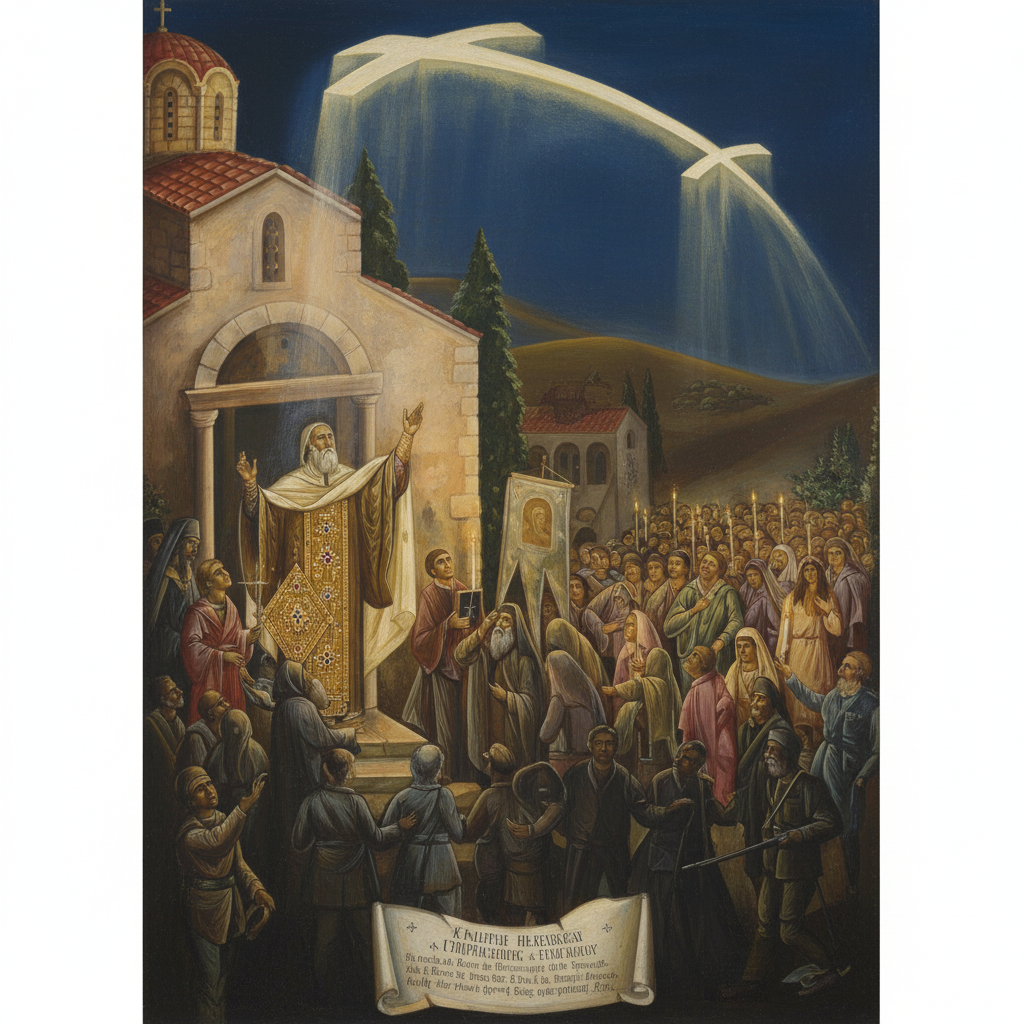
Icon · The Holy Fire at the Holy Sepulchre
From the Apostles to the 1924 Innovation
The Apostolic Calendar
The Apostles and the early Church used the Julian Calendar — established by Julius Caesar in 45 BC — to calculate the date of Pascha and coordinate the feasts of the liturgical year. This calendar became the sacred vessel of the Church's time.
The First Ecumenical Council at Nicaea
The Council of Nicaea established the canonical rules for calculating Holy Pascha, explicitly tying the feast to the Julian Calendar and the Jewish Passover sequence. This became a dogmatic commitment of the universal Church, binding on all Orthodox Christians.
The Papal Gregorian Reform
Pope Gregory XIII of Rome unilaterally reformed the calendar, advancing it by 10 days (later 13). The Orthodox Church, the Coptic Church, and the Eastern Churches universally rejected this as a papal innovation with no conciliar authority.
The Pan-Orthodox Congress of Constantinople
Under pressure from Freemasonic and modernist elements, a so-called 'Pan-Orthodox Congress' was convened in Constantinople — notably without the participation of most canonical Orthodox Churches. It proposed adopting the Revised Julian Calendar, bringing feast days into alignment with the Western Gregorian calendar.
Greece Imposes the New Calendar
The Church of Greece, under the government of Eleftherios Venizelos, unilaterally adopted the Revised Julian Calendar — advancing the liturgical year by 13 days overnight. Faithful Greeks awoke on March 1 to find it suddenly March 14. Fixed feasts were displaced; the unity of Orthodox Christendom was severed.
Persecution of the Genuine Orthodox Christians
Those who refused the new calendar — the Genuine Orthodox Christians of Greece — were subjected to systematic persecution: churches seized, clergy defrocked, faithful beaten by police, services raided. The state treated faithfulness to the ancestral calendar as sedition.
The Miracle of the Holy Fire on the Original Pascha
The Holy Fire descended at the Church of the Holy Sepulchre in Jerusalem on the date of Pascha according to the Original Calendar — not on the date observed by those who had adopted the new reckoning. This was widely understood by the faithful as a divine confirmation of the Original Calendar.
Three Metropolitans Return to the Original Calendar
Three Metropolitans of the Greek Church — Germanos of Demetrias, Chrysostom of Florina, and Chrysostom of Zakynthos — publicly broke with the new calendar and re-established the Church of the Genuine Orthodox Christians of Greece under the Original Calendar.
Continued Witness
Despite waves of persecution, the Genuine Orthodox Christians of Greece, Russia (Catacomb Church), Romania, Bulgaria, and beyond have maintained the Original Orthodox Calendar — the unbroken liturgical tradition of the Apostles and the Seven Ecumenical Councils.
The Persecution of the Genuine Orthodox Christians
When the Greek state imposed the new calendar in 1924, not all complied. Those who held fast to the Original Calendar were treated not as faithful Christians but as threats to public order.
Churches of the Genuine Orthodox Christians were forcibly seized by the Greek state and handed to the new-calendar hierarchy.
Clergy who refused the new calendar were stripped of their canonical standing, arrested, and imprisoned.
Faithful gathering for liturgy were dispersed by police, sometimes violently.
GOC bishops were placed under house arrest or exiled to remote islands.
Children of GOC families were sometimes denied civil registration and state services.
The Greek government classified GOC communities as illegal religious organizations.
Despite all this, thousands of faithful — including monastics, laywomen, and simple peasants — maintained the Original Calendar at great personal cost.
"They have the churches, but we have the Faith."
— St. Athanasius the Great · Applied by the GOC faithful
The Plan to Realign the Orthodox World with Rome
The 1923 Pan-Orthodox Congress, convened in Constantinople without the participation of most canonical Orthodox Churches, proposed a sweeping realignment of the Orthodox liturgical year.
Fixed Feasts Displaced by 13 Days
Christmas, Theophany, the Transfiguration, the Dormition of the Theotokos, and all other fixed feasts were advanced by 13 days — overnight — without preparation, without conciliar authority, and without the consent of the faithful.
Pascha Kept on the Original Calculation — For Now
The reformers retained the Original Calendar's Paschal calculation, creating a bizarre hybrid: fixed feasts on the new calendar, Pascha on the old. Some jurisdictions later moved to celebrate Pascha on the same date as Rome.
Orthodox Feasts Merged with Western Holidays
By moving Christmas to December 25 on the Gregorian reckoning, Orthodox Christians in new-calendar churches began celebrating on the same day as Roman Catholics and Protestants — an outcome the reformers considered desirable.
The Apostolic Fasts Were Disrupted
The Nativity Fast, the Apostles' Fast, and other penitential seasons were compressed or displaced by the calendar shift — disrupting the rhythm of ascetic preparation that had shaped Orthodox spiritual life for sixteen centuries.
Whatever the intentions of those involved, the practical effect was to realign the Orthodox liturgical year with Rome and the Protestant West — through administrative decree, without conciliar authority, and without the consent of the faithful who had kept this calendar for sixteen centuries.
Why We Keep the Original Calendar
"We do not change the everlasting boundaries which our Fathers have set, but we keep the Tradition as we received it."
— St. John of Damascus (†749)