Saint Nektarios of Pentapolis
Wonderworker · Metropolitan of Pentapolis · Patron of Our Parish
Feast Day: November 9 (Original Julian Calendar)
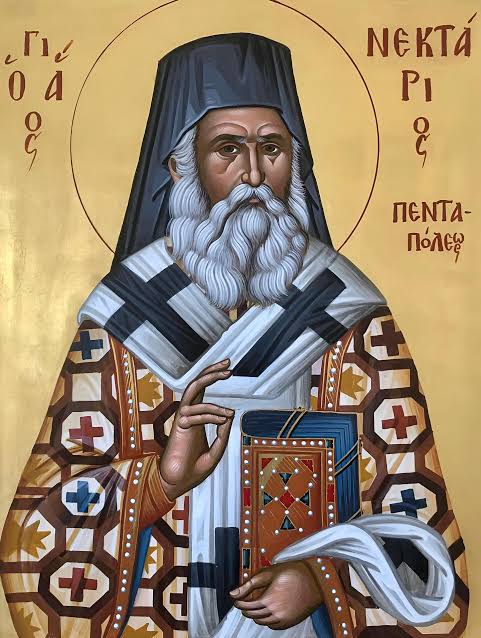
"The union of the churches is possible only in the Truth — the Faith once and for all delivered to the saints."
— St. Nektarios of Pentapolis, On the Unity of the Church (1920)
Born into Poverty, Raised to the Episcopate
Saint Nektarios (Anastasios Kephalas, 1846–1920) was born into deep poverty in Silivri, Thrace. His family had no means to educate him, yet a burning desire for God drove him from childhood. As a teenager he worked as a manual labourer in Constantinople, writing to wealthy benefactors begging for help — signing the letters simply: 'a poor child who is hungry for learning.'
Through extraordinary perseverance he reached the Patriarchal School of Halki, the great theological academy near Constantinople, where he distinguished himself as one of the finest students of his generation. He was tonsured a monk, ordained priest — and caught the attention of Patriarch Sophronios IV of Alexandria, who consecrated him Metropolitan of Pentapolis in 1889, placing him over the ancient apostolic see in North Africa.
Persecuted, Expelled, and Abandoned — by His Own Hierarchy
What happened to St. Nektarios was not merely difficult. It was a methodical ecclesiastical destruction carried out over decades, with the full power of institutional Orthodoxy arrayed against him.
Within a year of his consecration as Metropolitan, an orchestrated campaign of anonymous letters — filled with lies about his ambition, his conduct, and his alleged designs on the Patriarchal throne itself — was unleashed against him. He was given no opportunity to respond. No trial. No canonical process. No hearing. He was simply dismissed from his see by Patriarch Sophronios IV of Alexandria, stripped of his salary, and deported back to Greece with no official explanation and no means of support.
He arrived in Athens as a destitute bishop without a church. The Holy Synod of Greece refused to receive him. He could not celebrate liturgy. He could not perform his episcopal ministry. His reputation — the only capital a man of God possesses — had been destroyed by anonymous lies that were never retracted and never officially investigated. For years he survived in near-destitution, relying on the charity of strangers, unable to publicly defend himself without appearing to compound the offence.
He bore it. For decades. In total silence. Without bitterness. Without a single recorded act of retaliation against those who destroyed him. He continued to write theology. He continued to teach. He prayed without ceasing. He wept before the icon of the Theotokos and asked for nothing but the strength to endure.
This is not a footnote to his life — it is the entire shape of it. The man whom God vindicated as the greatest wonder-worker of the 20th century was, for the better part of his active ministry, a castaway from the very institution that was supposed to embody the Body of Christ. He knew from lived experience — not from books — what it means when the Church as institution becomes the enemy of the Truth.
This is why he is ours. The True Greek Orthodox Church has known exactly this experience: the full institutional weight of the official hierarchy — the Synod of Greece, the Ecumenical Patriarchate, and the Greek state — deployed against the faithful who refused the 1924 calendar innovation. Priests arrested. Liturgies stormed by police. Bishops exiled. A saint who endured the same is not merely an intercessor. He is a witness. A prototype. A guarantee.
Aegina: Monasticism, Miracles, and Repose
Eventually appointed director of the Rizarios Ecclesiastical School in Athens, he served there with great love, beloved by generations of students. In his final years he withdrew to the island of Aegina — obscurity, silence, peace — where he founded the Holy Monastery of the Holy Trinity for nuns, and spent his remaining years in unceasing prayer and theological writing.
After his repose on 9 November 1920, the miracles multiplied beyond counting. His body was laid on the bed of a paralytic in the hospital where he died — the man rose and walked. Thousands of documented healings, especially of cancer, followed across the decades. He became the most invoked wonder-working saint of the 20th century.
Why He Belongs to the Old Calendar Church
Saint Nektarios reposed on 9 November 1920 — exactly four years before the Greek Church, under Archbishop Chrysostomos Papadopoulos, unilaterally abandoned the Julian Calendar and imposed the Gregorian in 1924. He never lived under the innovation. He belongs entirely to the Church as it existed before — the undivided, unaltered, apostolic Orthodox Church that had always kept the ancestral calendar.
This is not a technicality. It is a theological fact of the first order. The faithful who refused the calendar innovation in 1924 — those who became the True Greek Orthodox Christians of Greece (Γνήσιοι Ορθόδοξοι Χριστιανοί) — did not leave the Church and did not form a new one. They remained exactly where they had always been. It was the innovating hierarchy that departed from the received Holy Traditions. The True Greek Orthodox did not go anywhere. They stayed.
His theological writings are an explicit repudiation of the ecumenist movement. In his treatise On the Unity of the Church, he wrote: 'The union of the churches is not achieved through compromise of the truth, nor through the silencing of doctrinal differences. Union is possible only in the Truth — the Faith once and for all delivered to the saints.' He wrote this years before the ecumenical movement institutionalized precisely the compromise he condemned.
Critically: the spiritual children whom St. Nektarios personally formed — the nuns of the Holy Trinity Monastery on Aegina, whom he guided as their father confessor and abbot — remained on the Old Calendar after 1924. His closest disciples, those who knew him best, chose the True Greek Orthodox path. Their witness is the most intimate testimony to where their elder's heart truly stood.
We therefore invoke St. Nektarios not merely as a powerful wonderworker, but as our own — a confessor who belonged to the Church of the Original Calendar, who wrote against the errors of ecumenism before ecumenism had a name, and whose entire life was a living icon of what it means to hold the Faith when the institutional powers of this world have abandoned it.
Ecumenism Is a Condemned Heresy — and He Said So First
St. Nektarios wrote clearly about the nature of Christian unity — and his words anticipate, with prophetic precision, the errors of the ecumenical movement that would emerge after his repose. We present his witness not to condemn those who disagree, but because we believe it contains a truth that matters deeply for the salvation of souls: that genuine unity among Christians can only be built on the foundation of the whole apostolic Faith, not on the negotiation of a common minimum. St. Justin Popovich of Serbia (†1979), who suffered greatly for the Faith, named the institutional ecumenical movement the 'pan-heresy' (πανεαίρεση) of our age: 'Ecumenism is the common name for the pseudo-Christianity of the pseudo-churches of Western Europe... all these pseudo-Christianities are nothing other than heresies.' We include this witness not in a spirit of condemnation, but as a call to seriousness — because we love our brothers and sisters in Christ too much to be silent about what we believe.
This condemnation is not the opinion of one theologian. It reflects the unbroken patristic witness from St. Paul ('if anyone preaches another gospel, let him be anathema') through St. Athanasius, St. Maximos the Confessor, St. Mark of Ephesus, and every confessor of the Faith who chose excommunication, exile, or death rather than false union with heresy. The canonical tradition of the Church — Apostolic Canon 45, Canon 33 of Laodicea, and many others — explicitly forbids common prayer with heretics. These canons are not suggestions. They are expressions of the Church's self-understanding.
The ecumenical movement, formally organized through the World Council of Churches (1948), rests on an understanding of the Church that Orthodox theology cannot share: that the Church of Christ is divided among several bodies, none possessing her fullness. The Nicene Creed confesses 'one, holy, catholic, and apostolic Church' — not as a future aspiration but as a present reality. The path to visible Christian unity, from the Orthodox perspective, is a return to the fullness of the Apostolic Faith — and this door is always open, always held with love.
St. Nektarios condemned this error forty years before the WCC was founded. In his 1920 treatise On the Unity of the Church — written in the same year as the Patriarchal Encyclical that first proposed the calendar innovation — he wrote: 'The union of the churches is not achieved through compromise of the truth, nor through the silencing of doctrinal differences. Union is possible only in the Truth — the Faith once and for all delivered to the saints. Any other union is a false peace and a betrayal.'
He did not live to see the 1924 calendar rupture, the formation of the WCC, or the 2016 Council of Crete. But he described the theological error underlying all of these things before any of them occurred. He is not merely a patron saint. He is a prophet — and we invoke his intercession not only for ourselves, but for all Christians, that God may grant to His whole Church the unity that is built on Truth.